The primary bathroom has replaced the formal living room as the luxury space that clients care most about — the space they want to get exactly right. When we ask clients what they’re imagining, the word that comes up most often is ‘spa.’ Here’s what that actually means in practice.
What Makes a Bathroom Feel Like a Spa
The spa quality that clients are reaching for isn’t primarily about equipment — it’s about sensory experience. Walk into a genuinely spa-like bathroom and what registers is the light (soft, diffused, without harsh shadows), the materials (stone, wood, warm textiles), the temperature (the floor is warm, the towels are heated), the sound (quiet — no mechanical noise), and the proportion (the room doesn’t feel crowded).
Those qualities are design decisions, not shopping decisions. You don’t achieve a spa bathroom by specifying an expensive tub. You achieve it by designing the room so that every sensory input reinforces the same experience.
Materials That Define the Spa Experience
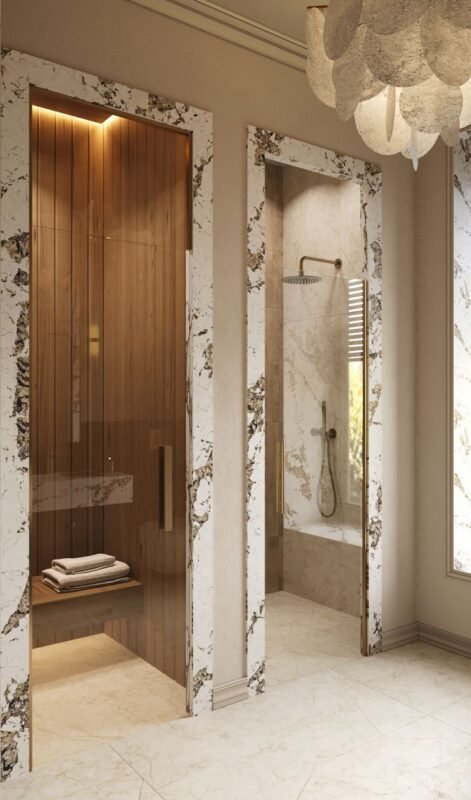
Natural stone is the foundational material of spa bathrooms. The reasons are both sensory and practical: stone has thermal mass, so it holds warmth from radiant floor heating. It has depth and variation that manufactured surfaces don’t replicate. Marble, quartzkte, travertine, and limestone are the most common choices.
Wood in a wet environment requires careful selection and proper sealing, but where it’s used well — teak shower benches, walnut floating vanities, cedar accent walls — it adds warmth that stone alone can’t provide. Large-format tile minimizes grout lines and creates a cleaner, more expansive visual field.
Lighting Design for the Spa Bathroom
Spa bathroom lighting requires at minimum two layers: ambient lighting for overall illumination and mirror/vanity lighting that illuminates the face from the front rather than above. This typically means wall-mounted sconces flanking the mirror at eye level.
Beyond function, spa bathrooms use lighting to create mood. Dimmer controls on all circuits allow the room to shift from a bright grooming environment to a soft, ambient retreat for a bath. Natural light is the most flattering light source of all — where windows are possible near the vanity (with appropriate privacy glazing), we prioritize them.
The Features Worth Investing In
Radiant floor heating is consistently among the highest-rated investments. The sensory experience of a warm floor underfoot — especially on a stone surface in a Pacific Northwest morning — is immediate and lasting. A large, well-specified shower is almost always worth investing in relative to a freestanding tub. Steam shower integration adds a genuine spa experience. High-quality plumbing fixtures — specifically the hand feel of controls and the quality of water delivery — are felt every day.
Frequently Asked Questions
What’s the minimum size for a spa-quality primary bathroom?
Spa-quality bathrooms typically feel constrained below about 80 square feet. The spatial quality — the sense of room to move, to have a soaking tub set apart from the shower, to have a dressing area — requires some square footage. That said, a very well-designed smaller bathroom can feel more spa-like than a larger bathroom designed poorly.
How long does a primary bathroom renovation take?
For a full primary bathroom renovation, plan for eight to fourteen weeks of construction depending on scope and contractor availability. Design and specification, which happens before construction, typically takes six to ten weeks. Starting the design process earlier gives you more time to make selections without being rushed.
Should I use marble or quartzkte in a spa bathroom?
Both are beautiful and appropriate. Marble is softer and more susceptible to etching from acidic products — it requires more maintenance. Quartzkte is harder and more resistant. For shower walls and floors where products are used daily, quartzkte or other durable stones are often preferred. For a feature wall or soaking tub surround, marble is a beautiful choice.
Can a spa bathroom work with my home’s existing plumbing locations?
Moving plumbing requires cutting into the floor and potentially the substructure below. It’s more complex than surface renovation and adds cost. We assess what’s possible and what the relative cost-benefit of relocation is for each project.
If you’re ready to design a primary bathroom that actually delivers a spa experience — not just a spa-adjacent one — we’d like to hear about your space. Let’s begin.
Related: /primary-suite-design-seattle/ | /custom-closet-design-bellevue/ | /services/interior-designing/ | /our-process/